
Melbourne
Below is a mock up of a Traffic Light Voting Guide for Footscray. The Melbourne guide for voters will not be published until after the ballot draw on Tuesday November 10th.
Below is a mock up of a Traffic Light Voting Guide for the Victorian Upper House in the NORTHERN METROPOLITAN REGION. The actual guide for voters will not be published until after the ballot draw on Tuesday November 10th.
Voting Traffic Light in the 2026 Victorian State Election
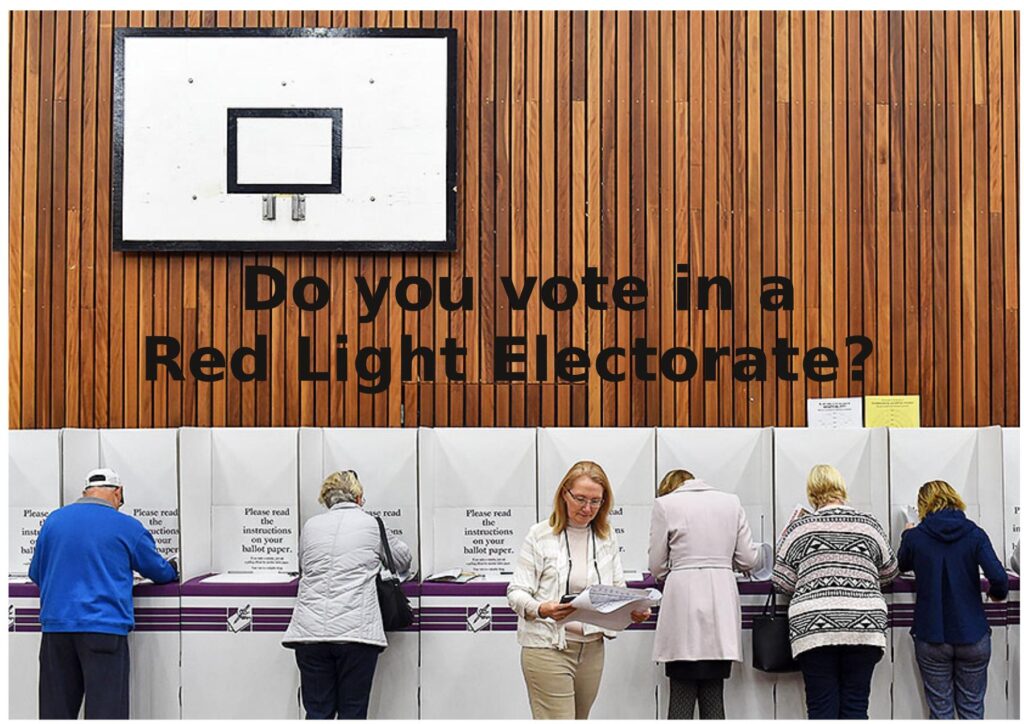
You will receive two ballot papers to vote for your preferred candidates in the Victorian House of Assembly and the Victorian Legislative Council .
To vote Traffic Light, vote for all the Green Light candidates or parties first, then the Orange Light ones. Number the red light candidates last.
Red light candidates are threat to achieving a fair future for us all not just in relation to Climate Rescue, but also a range of social issues most of us are concerned about. The order you number the Red Light candidates will have a significant effect on creating a good outcome at this election. We describe this advice as Strategic Preferencing. Strategic Preferencing combined with your Traffic Light Voting Guide will turbo charge the effectiveness of your vote in Red Light electorates.
Strategic Preferencing in the Melbourne District (How to turbo-charge your vote!)
Melbourne is not a Red Light electorate but, bear in mind, we have not, as yet, completed our assessments of the candidates and parties. Nevertheless we anticipate you will have at least three Green Light candidates to vote for before the rest of the pack in your House Assembly ballot.
Strategic Preferencing in the Western Metropolitan Region
Your Legislative Council ballot vote could be pivotal to the election of the fourth of fifth representative.
Whether you vote below, or above the line, number One Nation or their candidates stone motherless last. The divisiveness promoted by this party will tear us apart. Your vote can help to exclude them from minority government and preserve our capacity to restore social cohesion. They have an unhinged madness which will take a wrecking ball to the good influence of the Legislative Council on Government decision making.
To make certain that there is no chance that your ballot will be exhausted before the fifth candidate is decided we suggest you fill in all the boxes either above the line or below the line.
We repeat… number One Nation or their candidates last!
Green Light Candidates
Naomi Jones Animal Justice Party

Jordan Van Dem Lamb

TBA
Naomi Jones Animal Justice Party Candidate
Naomi Jones is a compassionate vegan and long-time animal advocate, standing as a candidate for the Animal Justice Party in the seat of Melbourne for the 2026 Victorian State Election.
Naomi holds a Master of Design Communication (with Distinction), a Diploma of Interior Design, and a Diploma of Dental Technology.
She brings extensive grassroots experience through years of community support work, particularly assisting people experiencing homelessness and vulnerability.
The Climate Emergency
The Animal Justice Party (AJP) is the only political party with policies that comprehensively take into account all sources of emissions, including the impact of animal agriculture and land clearing on the global climate, and the need to urgently transition to a plant-based diet in order to address the climate crisis.
The AJP will take urgent action to address the climate emergency. In addition to phasing out fossil fuels, we will transition from animal agriculture towards more sustainable plant-based farming, and transform other climate-threatening industries and practices. This is essential not only to reduce harmful emissions, but also to protect nature, and human and other animal life.
Key Objectives
- Declare a climate emergency and biodiversity emergency at every level of government as the first step towards systemic change and climate justice.
- Rapidly transition from animal agriculture to plant-based agriculture and promote plant-based diets.
- Protect, regenerate, expand, rewild and enhance all ecological systems including forests, grasslands, freshwater and marine habitats, in part by reserving at least 50% of the planet for nature (see our Policies on Human Population, Land Clearing and Marine Animals).
- Develop water management policies that are responsive to climate change and that prioritise animals, the environment and people over commercial interests (see our Water Management Policy).
- Develop and fund comprehensive plans and actions to assist all animal species and vulnerable human populations to adapt to a changing climate.
- Rapidly phase out fossil fuels and transition to clean energy infrastructure (see our Energy Policy).
- Commit to ambitious emission reduction targets which do not encourage dead end ‘solutions’, such as natural gas (see our latest Election Platform).
- Remove subsidies from the fossil fuel and animal agriculture industries in the interim and redirect funding into clean energy solutions and sustainable plant-based agriculture.
- Shift away from road transport toward more environmentally-friendly modes, including rail and mass transit, together with walking and cycling (see our Land Transport Policy).
- Reimagine urban design to be climate-friendly and climate-resilient, and incentivise research and development into net zero carbon building materials and practices.
Traffic Light Voting Assessment
Animal Justice Party has signed up to the Climate Rescue Accord, the 3Rs and the Green Transition
Jordan Van Den Lamb Victorian Socialists
Hi, I’m Jordan. I’m running in this year’s state election as the Victorian Socialists candidate for Melbourne.
For years, I’ve been exposing how broken our housing system is through my website shitrentals.org and my work online as ‘purplepingers’. I’ve visited people living in houses blackened by mould or with exposed asbestos who know that that’s just the price you pay to (barely) afford to live near the city. Meanwhile, there are more than enough empty homes across the city to house everyone homeless or in need.
Melbourne is run for the rich. Elections are even rigged in their favour – state law gives businesses and landlords two votes in Melbourne City Council elections, while ordinary people get one. At the same time, bulk-billed medical care has almost disappeared, and public institutions like our museums and the State Library are consistently under attack. Property developers, banks and big corporations make a killing while working-class people are forced to choose between housing, food and healthcare.
It doesn’t have to be like this. It’s a lie that we can’t afford decent housing, a genuine climate transition, or properly funded schools, hospitals and public transport. We could cut politicians’ $200,000-plus salaries and impose real taxes on the super-rich. Or, instead of pouring resources into jailing the most vulnerable in society and dragging activists through the courts, we could target the real criminals – property hoarders who leave homes empty or lease out unsafe, overpriced rentals.
I’m a CPSU delegate and have worked as a public servant in Melbourne for six years. I’ve stood with workers and communities against cuts to Cohealth and the State Library, supported striking Woolworths warehouse workers, and used my platform to back campaigns to free Palestine, oppose racism, and shut down fossil fuels.
If elected in November, I’ll fight for a city that puts people before profit.
Addressing climate change and protecting our environment
The climate emergency is a dire threat to our natural environment and the liveability of our cities. Victoria’s Climate Science Report 2024 projects hotter summers, more frequent and severe bushfire weather, reduced water availability, rising sea levels, and intensified short-duration flooding. Victoria’s greenhouse gas emissions were 84.2 million tonnes of CO2-equivalent in 2023 with around 90 percent of those emissions coming from burning fossil fuels, and electricity generation alone accounting for 46 percent. The Allan government’s targets fall well short of what climate science requires of wealthy developed states to limit warming to 1.5°C. In 2025, the Allan government opened up a new offshore gas exploration program, a pivotal policy shift after years of more restrictive measures, and locking in fossil fuel development that will generate emissions for decades and is incompatible with any credible path to net zero.
Victorian Socialists acknowledge that climate change is an existential risk with the potential to impact all other aspects of our policy platform and believe the climate emergency demands a response that matches the scale of the threat. The cost of the transition must fall on those who created the crisis and have profited from it.
What we think
- Climate change is a direct product of the capitalist world economy, which turns everything in the natural environment into a resource exploitable for private profits.
- Market mechanisms such as carbon trading, offsets, and voluntary targets have had decades to work and have failed. Climate change cannot be addressed without a comprehensive, planned restructuring of the economy away from fossil fuel dependence.
- The concentration of greenhouse gases already in the atmosphere means that net-zero emissions will not be sufficient to curtail dangerous warming. Net-negative emissions — actively drawing down atmospheric carbon — will be required.
- Nuclear power is neither clean nor renewable.
- The effects of climate change are disproportionately felt by people on low incomes; their lives and livelihoods need to be protected not only from changes to the climate, but during the transition to a new economy.
- The economic burden of dealing with climate change must fall solely on those who have profited from destroying the environment: the ultra-rich and the big polluters.
- The renewable transition, if publicly owned and democratically controlled, is an opportunity to rebuild Victoria’s manufacturing capacity, create skilled and secure employment, and revitalise regions that have borne the costs of the fossil fuel economy for generations.
- Policy should be focused on mitigation of the crisis rather than adaptation.
We’ll fight to
Emissions targets
- Reduce emissions by 75 percent below 2005 levels by 2030, achieve a zero-carbon economy by 2035 and a permanent net-negative emissions economy by 2040.
Fossil fuel phase-out
- Accelerate the closure of all remaining coal-fired power generation, with Loy Yang A to close no later than 2030 rather than its current scheduled date of 2035, with guaranteed jobs, income support and community investment for all affected workers and regions.
- Reverse the Allan government’s 2025 offshore gas exploration program, prohibit the development of all new fossil fuel projects — onshore and offshore.
- Make environmental approval for any new resource development contingent on full greenhouse gas emission neutrality.
- Stop the establishment of a nuclear power industry in the state.
Sustainability
- No new data centres. Data centres have detrimental environmental footprints, disproportionately high water and electricity demands, and no community benefits to the areas they are placed.
- Require existing data centres to meet mandatory standards on water consumption, energy use and renewable energy sourcing, with binding targets and enforceable penalties for non-compliance.
- End all planned waste to energy schemes and ban the creation of future waste incinerators.
Renewable transition
- Urgently construct solar and wind farms and upgrade the power grid with battery storage to enable the quick transition of Victorian homes and businesses to an all-electric, post-gas energy system.
- Establish a renewables manufacturing industry (solar photovoltaic, lithium-ion battery and electric vehicles), with guaranteed secure jobs and retraining for workers from the fossil fuel industry.
- Electrify Victoria’s transport system and commit to 100 percent electric new car sales by 2035, establish a comprehensive fast-charging network across the state including regional and rural areas, electrify the public bus fleet, and end all subsidies and concessions for fossil-fuel vehicles.
Nature and carbon stores
- Protect, restore and expand Victoria’s natural carbon stores — defending and extending the end of native forest logging introduced in January 2024, establishing large-scale programs of reforestation, restoring native grasslands and wetlands, and protecting blue carbon ecosystems in coastal and estuarine areas.
Adaptation
- Fund research into adaptation strategies to protect biodiversity, water resources and agricultural yields.
- Develop a comprehensive urban heat adaptation strategy — including mandatory tree canopy targets, green roofs and walls, shading requirements in new developments, cool corridors in areas of high heat stress, and publicly funded cooling centres accessible to vulnerable communities.
- Require all new public buildings and public housing to be built to standards that protect residents from extreme heat without reliance on air conditioning, and fund retrofitting of existing public housing stock to the same standard.
- Develop a managed retreat framework for communities facing unacceptable risk from rising sea levels, flooding and fire, with full financial support for affected working-class residents, no forced relocations without genuine community consent, and particular attention to renters and low-income households with no capacity to relocate.