
Nepean
Below is a mock up of a Traffic Light Voting Guide for Footscray. The actual Nepean guide for voters will not be published until after the ballot draw on Tuesday November 10th.
Below is a mock up of a Traffic Light Voting Guide for the Victorian Upper House in the WESTERN METROPOLITAN REGION. The EASTERN REGION guide for voters in Nepean will not be published until after the ballot draw on Tuesday November 10th.
Voting Traffic Light in the 2026 Victorian State Election
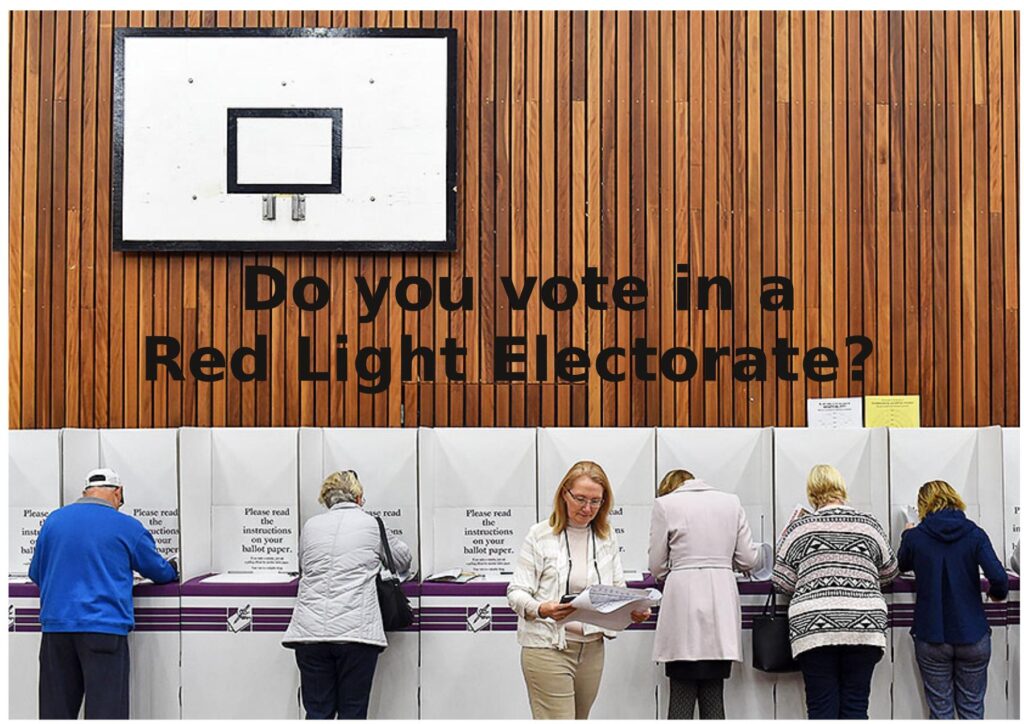
You will receive two ballot papers to vote for your preferred candidates in the Victorian House of Assembly and the Victorian Legislative Council .
To vote Traffic Light, vote for all the Green Light candidates or parties first, then if there are any Orange Light ones number them next. Number the red light candidates last.
Red light candidates are threat to achieving a fair future for us all not just in relation to Climate Rescue, but also a range of social issues most of us are concerned about. The order you number the Red Light candidates will have a significant effect on creating a good outcome at this election. We describe this advice as Strategic Preferencing. Strategic Preferencing will turbo charge the effectiveness of your vote in Red Light electorates.
Strategic Preferencing in Nepean
Nepean is a Red Light electorate. In this seat we strongly advise you preference the Libs last. You are also lucky enough to have Kim Robbins a very worthy community independent and an Outstanding Green Light candidate standing in Nepean. You have other Green Light candidates to vote for before the Red Light candidates.
Strategic Preferencing in the Eastern Victorian Region
Fortunately you also have an Outstanding Green Light candidate to vote for in Eastern Victoria Region.
Whether you vote below, or above the line, number One Nation or their candidates stone motherless last. The divisiveness promoted by this party will tear us apart. Your vote can help to exclude them from minority government and preserve our capacity to restore social cohesion.
To maximise the effectiveness of your Upper House vote you advise you to fill in all the boxes either above the line or below the line.
Outstanding Green Light Candidates
Kim Robbins
Community Independent for Nepean

Policy Priorities
Peninsula Link
Peninsula Link opened in 2013. Just 13 years later, 14 kilometres is being dug up and rebuilt, yet the reports explaining why remain hidden. The government must show whether the road was built and maintained to standard, whether the contract was enforced and who is accountable. I’ll pursue the answers through Parliament, Freedom of Information and independent scrutiny, then publish every answer, and every refusal, in plain English.
Housing & Homelessness
It breaks my heart that the Peninsula is one of the state’s winners of the most rough sleepers “award”. We know that short-stay accommodation exacerbates the supply issue, but what of the revenue from the Air BnB levy, a huge proportion of which is generated here? And when you compare State funding for housing and support services, we are definitely not getting our fair share. The $2.1m promised to fund 2 outreach workers on the Peninsula is a great start but not enough.
Local skills, local jobs
Nepean needs more qualified tradies, care workers and early childhood educators, and many of the courses leading to these jobs are already taught at Chisholm’s Rosebud campus. But costs, transport, workplace conditions and confusing support schemes can stop people starting or finishing. I’m surveying local learners and employers, then bringing them together for a local skills roundtable to shape practical solutions.
A fair classification for the Peninsula
The Peninsula is treated as metropolitan Melbourne despite our spread-out townships, limited public transport, older population and visitor pressures. That leaves us excluded from support available to regional communities. I’ll fight for fair peri-regional treatment and access to funding that reflects our real needs, while protecting the Green Wedge and the metropolitan programs that benefit us. Each year, I’ll publish what the government promised, funded and delivered.
Rosebud Hospital
Rosebud Hospital’s emergency department operates around the clock, but essential diagnostic services don’t. Patients can wait for imaging and urgent blood-test results, while our community fundraises for a replacement CT scanner. I’ll push for these immediate service gaps to be fixed, demand the release of Rosebud’s hidden plans and funding history, and pursue a fully funded redevelopment with a clear scope, budget and timetable.
Small business and the local economy
Our cafes, shops, trades, tourism operators and family businesses keep the Peninsula working, but each faces different costs and barriers. I’ll bring local chambers and business owners together to identify the state taxes, charges, regulations and delays hurting them most, then push for practical changes. I’ll also fight for eligible Peninsula employers to receive the same lower payroll-tax rate available to eligible regional employers.
Community safety
Everyone deserves to feel safe at home, on our streets and in our shopping centres. That requires visible, responsive local policing and early help that prevents further offending. I’ll fight to keep the Peninsula’s High Visibility Community Engagement Team local and properly resourced, and push to bring Victoria Police’s youth outreach program here. This isn’t about excusing crime. It’s about preventing the next offence and reducing the number of victims.
Western Port Bay
A healthy Western Port supports local jobs, businesses, fishing, boating and tourism, as well as wetlands and wildlife. I’ll push the Victorian Government to adopt and fund the community-developed Western Port Bay Framework, creating one plan for the bay and its catchment, shared responsibility and dedicated annual funding. Regular public reporting will show whether water quality, sediment, shorebirds and restoration work are genuinely improving.
Traffic Light Voting Guide Assessment
1. “If I am elected to the next Victorian Parliament as the Member for Nepean, I will support real and meaningful action on issues relating to the ecological and climate emergency.”
2. ” I support the application of the 3Rs (Reduce, Remove, Reflect) and the Climate Rescue Accord to inform, when relevant to the bill at hand, my position and advocacy on legislation and policy.”
I’ve listed you on our Pledges page here. https://www.kimrobbins.com.au/pledges/
Antoinette Pitt
Community Independent for the Eastern Region

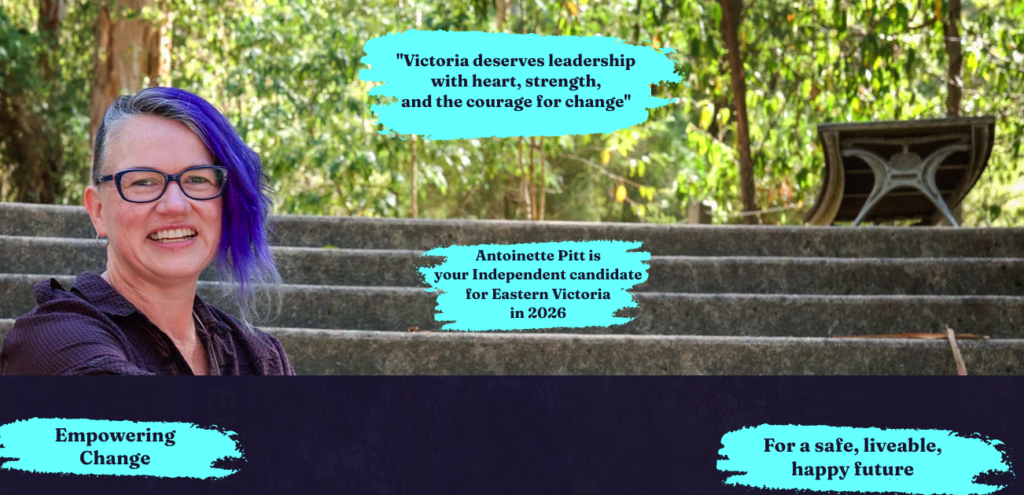
I grew up in Lilydale, my husband in Mooroolbark, and our family now enjoys living in Montrose. This region has shaped who I am. It’s where we’ve built our lives, and where I’m committed to giving back.
My nursing career has taken me to Traralgon, Bairnsdale, and Phillip Island, giving me an understanding of the diverse communities and health challenges across our region. As a dedicated nurse and advocate, I have seen firsthand the challenges faced by frontline workers, patients, and everyday Victorians.
As a Job Representative with the Australian Nursing & Midwifery Federation (ANMF), I have fought for fair wages, better working conditions, and stronger protections for healthcare workers. I bring those same values—of fairness, dignity, and community—into my campaign, because I believe Eastern Victoria deserves leadership grounded in lived experience and real care for our future.
Vote Climate One Assessment
1. If you are elected to the next Victorian House of Assembly will your policy focus support real action on issues relating to the ecological and climate emergency?
When elected to the next Victorian Parliament, I will support real action on issues relating to the ecological and climate emergency.
Tangible actions such as growing circular capabilities, increasing recycling, pushing for Victoria to lead the way with Resource Rescue hubs which provide access to single stream recycling, tool libraries, repair cafes, reuse swaps, education and generally support a communities sustainability.
I will advocate for maximum carparking without solar roofing and more electric chargers in our communities.
I will support the growth of energy diversification and community access. Regional and rural towns should not have to rely on diesel generators because private power companies refuse to service them reliably.
2. Are you prepared to use the application of the 3Rs, the Climate Rescue Accord and the Green Transition to inform, when relevant, your position and advocacy on legislation and policy?
After decades of dragging our feet we are getting close to passing the 2 degree increase to our global average temperature. We are already experiencing the deterioration of our environment and ecosystems.
It is no longer just enough to plant trees and issue empty credits. To ensure we can have a happy, healthy, livable future, we must find ways to support farmers with new techniques and technology to protect our food security. We need techniques to slow down ecosystem collapse and prevent further harm to our environment. And we need to ceased digging up Fossil Fuels.
I support the application of the 3Rs and the Climate Rescue Accord to inform my position and advocacy on legislation and policy when relevant.
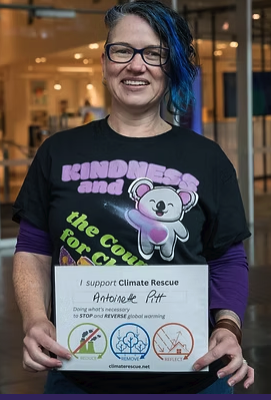
Green Light Candidates
Sianan Healy Greens Candidate

Tamara Champion Animal Justice Party

Reade Smith SAP for Eastern VIC

Sianan Healy Greens Candidate

I am a non-profit leader in women’s health and equitable health care, proud to serve our community and care for environment in Nepean where we will build a campaign centered around the fight for our climate and social justice. I will be a representative that engages with and fights for all of our community in Nepean.
As an engaged member of my local community, I listen to and talk with locals raising children in our public schools, working in local health services, schools, arts and hospitality, sometimes struggling to pay bills or rent – and from these conversations it is clear that the status quo is failing the Peninsula.
My family instilled me with the value of service to the community and that is grounding me in my motivation to represent the Greens in Nepean and contributing to a better and more just world.
Climate Change Policy
All of our state policy principles and aims should be read alongside our relevant federal policy principles and aims, as well as our state campaigns and federal campaigns.
Principles
- Human-induced climate change poses one of the greatest threats to our world in human history and requires urgent local, national and global action.
- We are already experiencing dangerous impacts of climate change; urgent, deep, and broad action is required to avoid catastrophic impacts.
- The amount of greenhouse gases already in the atmosphere necessitates urgent emission reduction and drawdown of greenhouse gases as well as prompt adaptation to climate change.
- Early action to reduce greenhouse emissions is cheaper and fairer than delayed action.
- Governments must ensure that organisations responsible for pollution pay for the costs of mitigating climate change and adapting to its impacts.
- Climate change policy should be based on the best available science.
- Climate change policy should inform and frame all other policies.
- Victoria must take responsibility for the greenhouse gas emissions resulting from the goods and resources it consumes and exports.
- Victoria is one of the world’s largest per-capita emitters of greenhouse gases with a large percentage due to the burning of brown coal.
- The lack of effective global (or Australian) climate action must not prevent Victoria from taking immediate and comprehensive measures.
- Offset schemes must be carefully controlled to avoid them undermining emissions reduction efforts or being used for greenwashing or fraud.
- Climate action should prioritise proven solutions such as large-scale reforestation over unproven or harmful technologies that prolong fossil fuel use.
- Climate change adaptation and mitigation measures should not discriminate or treat anyone unfairly on any basis including gender, age, race, ethnicity, vulnerability, religion, disability, sexual orientation or membership of a minority group.
Aims
Mitigation
- To achieve net zero or negative total greenhouse gas emissions across all areas of human activity – including via the removal of greenhouse gases already in the atmosphere, in a way that is environmentally responsible and socially fair.
- Development and implementation of a detailed plan to end Victoria’s reliance on fossil fuels by shifting to, and beyond, a zero greenhouse gas emission economy.
- Position Victoria – through appropriate investment in technological innovation – to benefit from the new jobs, skills, technologies and markets available in a zero greenhouse gas emission economy.
- Provide transitional support for all regions, businesses and communities adversely affected by measures that reduce climate change.
- Support place-based adaptation and mitigation initiatives which engage the community in identifying local challenges and co-designing solutions.
- Regulation of the phasing out of existing coal-fired power stations and the banning of new fossil-fuel based power stations.
- A ban on the exploration and development of new fossil fuel resources including but not limited to coal seam gas and other forms of unconventional gas.
- Develop complementary mitigation measures in collaboration with other governments where possible.
- Support for elevating sustainability requirements for buildings and construction.
- Where practical, support nature-based responses to climate change, such as increasing canopy cover, and planting mangroves to reduce storm damage to coastal areas.
- Assistance to the agriculture and forestry sectors to reduce emissions from ruminant livestock production and land clearing and other sources.
- Maximise effective and sustainable carbon farming, bio-sequestration and other drawdown methods.
- Implement low-cost, high-impact emissions reductions in Victoria’s stationary energy sector, and reduce emissions across other sectors including transport, industrial processes, agriculture and forestry.
Adaptation
- Government support for adaptive actions to protect the environment and key public assets, and to manage major public risks.
- The implementation, through public and private action, of Victoria’s climate change adaptation action plan, and ongoing review with community and expert involvement.
- Assisting the agriculture sector to adjust to reduced water availability and to make itself more energy self-sufficient.
- Ensuring that planning regulations allow for expected impacts of climate change such as rising sea levels, storm surges and other extreme weather events.
- Implement adaptation measures that take account of those groups disproportionately impacted by climate change and resulting disasters and emergencies.
Further reading
- Climate change and energy (federal Greens policy)
- No more coal and gas (state campaign)
Greens state policies
Tamara Champion Animal Justice Party Candidate
Tamara Champion is an environmental scientist, animal advocate, and life long resident of the Mornington Peninsula who is standing as the Animal Justice Party candidate for Nepean to be a voice for animals, the environment and the local community.
Tamara grew up on the Mornington Peninsula and believes that it is truly one of Victoria’s most special places, defined by its beautiful beaches, bushland and wildlife. Growing up surrounded by nature and rescue animals, she developed a lifelong appreciation for this unique environment, along with a deep belief that animals deserve kindness, respect and protection.
She holds a Bachelor of Environmental Science (Wildlife and Conservation Biology) from Deakin University and has spent the past decade working in bushland restoration, restoring native vegetation, protecting biodiversity and helping conserve threatened ecosystems on the
Peninsula.
The Climate Emergency
The Animal Justice Party (AJP) is the only political party with policies that comprehensively take into account all sources of emissions, including the impact of animal agriculture and land clearing on the global climate, and the need to urgently transition to a plant-based diet in order to address the climate crisis.
The AJP will take urgent action to address the climate emergency. In addition to phasing out fossil fuels, we will transition from animal agriculture towards more sustainable plant-based farming, and transform other climate-threatening industries and practices. This is essential not only to reduce harmful emissions, but also to protect nature, and human and other animal life.
Key Objectives
- Declare a climate emergency and biodiversity emergency at every level of government as the first step towards systemic change and climate justice.
- Rapidly transition from animal agriculture to plant-based agriculture and promote plant-based diets.
- Protect, regenerate, expand, rewild and enhance all ecological systems including forests, grasslands, freshwater and marine habitats, in part by reserving at least 50% of the planet for nature (see our Policies on Human Population, Land Clearing and Marine Animals).
- Develop water management policies that are responsive to climate change and that prioritise animals, the environment and people over commercial interests (see our Water Management Policy).
- Develop and fund comprehensive plans and actions to assist all animal species and vulnerable human populations to adapt to a changing climate.
- Rapidly phase out fossil fuels and transition to clean energy infrastructure (see our Energy Policy).
- Commit to ambitious emission reduction targets which do not encourage dead end ‘solutions’, such as natural gas (see our latest Election Platform).
- Remove subsidies from the fossil fuel and animal agriculture industries in the interim and redirect funding into clean energy solutions and sustainable plant-based agriculture.
- Shift away from road transport toward more environmentally-friendly modes, including rail and mass transit, together with walking and cycling (see our Land Transport Policy).
- Reimagine urban design to be climate-friendly and climate-resilient, and incentivise research and development into net zero carbon building materials and practices.
Traffic Light Voting Assessment
Animal Justice Party has signed up to the Climate Rescue Accord, the 3Rs and the Green Transition
Reade Smith standing in the Eastern Victoria Region for the Sustainable Australia Party

Reade lives on the Mornington Peninsula and has 12 years of local government political experience as a former councillor with Mornington Peninsula Shire Council from 2000 to 2012 and was mayor in 2005. He has experience as a candidate and campaigner in local, state and federal elections.
Reade is also a former Senior Constable with the Victoria Police, having been stationed at a number of police stations including Rosebud, Mornington and Frankston. He retired from Victoria Police to manage a Frankston-based youth leadership and empowerment program called Youth At Risk. He is currently employed as a Senior Construction Liaison and Compliance Officer at a south-east Melbourne council.
Reade is a dedicated community advocate and is passionate about creating an environmentally sustainable, socially just and economically healthy society. He has a demonstrated commitment to the Mornington Peninsula’s diverse community and is particularly concerned by the affordable housing crisis and homelessness, environmental and climate change issues, regional infrastructure and community development.
Reade represented the Mornington Peninsula Shire as a Director of the UNESCO Western Port Biosphere, to help create a sustainable future for Western Port. Reade also represented the Mornington Peninsula Shire on the Inter Council Aboriginal Consultative Committee for four years.
In 2000 Reade was co-opted onto the council of his former high school, Mt Eliza Secondary School College, for eight years where he gained a detailed knowledge of the secondary school system.
Reade and his partner Amanda have been married for over 25 years. He has two adult daughters and five grandchildren, enhancing his desire to create a more sustainable Australia.
Environment Policy | Sustainable Australia Party
In short:
Recognise that a healthy natural environment is the foundation upon which all human wellbeing and prosperity is built, and so prioritise environmental sustainability to better protect, manage and restore Australia’s fragile and unique natural environment
- Enshrine into Australian law the fundamental human right of a healthy natural environment
- Significantly reduce Australia’s waste production
- Act on climate change and contribute to staying below 1.5 degrees global temperature rise compared to pre-industrial levels