
Brighton
If you print the Brighton Traffic light Voting guide (scroll down) you can fill it in at home and take it with you when you head off to vote. Alternatively you can follow the guide by using the image on your phone as a prompt.
To view or print the Bentleigh Brighton Traffic Light Voting Guide click on the print icon in the top RH corner of the pdf file below.
If you print the SOUTHERN METROPOLITAN REGION guide (scroll down) you can also fill it in at home and take it with when you head off to vote. Alternatively you can follow the guide by using the image on your phone as a prompt.
To view or print your Region Traffic Light Voting Guide click on the print icon in the top RH corner of the pdf file below.
Voting Traffic Light in the 2026 Victorian State Election
You will receive two ballot papers to vote for your preferred candidates in the Victorian House of Assembly and the Victorian Legislative Council .
To vote Traffic Light, vote for all the Green Light candidates or parties first, then the Orange Light ones. Number the red light candidates last.
Red light candidates are threat to achieving a fair future for us all not just in relation to Climate Rescue, but also a range of social issues most of us are concerned about.
Traffic Light Voting Help Line>>>>>>> 0427 580 803
If you find this number is busy please text your number through to us and we will ring you back.
Whether you vote below, or above the line In Victoria’s Upper House, number One Nation or their candidates last. The divisiveness promoted by this party will tear us apart. Your vote can help to exclude them from minority government and preserve our capacity to restore social cohesion. They have the unhinged capacity to take a wrecking ball to the good influence of the Legislative Council as a House of Review. Number each of the major parties second and third last.
Using strategic preferencing, as outlined above, in the Southern Metropolitan Region is very important to protecting the role of the Legislative Council as a genuine House of Review.
For the most effective strategic preferencing fill in all the boxes either above the line or below the line.
Outstanding Green Light Candidates
Community independent Melissa Lowe has been assessed by the Traffic light Voting Team as an Outstanding Green Light Candidate. Melissa is standing in all eleven elctorates for the Southern Metropolitan Region for the Victorian Legislative Council

Why the upper house matters
It’s meant to double-check government’s laws before they pass, a safeguard against one party having free rein. Melissa Lowe our Community Independent is the watchdog it’s been missing.
Climate and clean energy
What this means for you: lower bills, reliable power and a safer climate for your kids.
I will use my vote and committee work to:
- Strengthen Victoria’s legislated targets, aiming to reach net zero well before 2045. I will push for yearly milestones, public reporting and independent advice so we can track progress and meet our targets.
- Speed up renewable energy generation, transmission and storage, with transparent planning, fair benefits for host communities and published reliability checks.
- Ensure no household is left paying more or going cold as we move away from gas. I will support funding for electrification and efficient appliances, prioritising low-income households, renters and apartment owners.
- Oppose new coal and gas extraction and end fossil fuel subsidies. Before approving a new gas pipeline or import terminal, require the government to show that reducing gas demand through efficiency, electrification and storage would not be cheaper.
- Make rooftop solar and batteries accessible to everyone, including renters, apartment residents and people in heritage homes, where red tape can be a greater barrier than cost.
- Defend the end of native forest logging, restore habitat and water catchments, and support workers and communities through a fair transition.
- Prepare for heat, floods and fires with more tree canopy, cooler and more resilient housing, and properly funded emergency services.
Traffic Light Voting Assessment
Melissa has signed up to the Climate Rescue Accord, the 3Rs and the Green Transition
Green Light Candidates



Ebony Bain Greens Candidate

I’m a Bayside local, renter and educator with a background in science communication. I understand the cost of living challenges facing the Brighton community, from unaffordable housing to groceries and healthcare.
My role in the education space has given me firsthand insight into the need for more action on climate change, and my academic background focuses on the role that communication plays in the space. The impacts of climate change are being felt by our community and I’m committed to listening to locals so we can build solutions together.
I’m deeply committed to building a better future for the next generation. Our campaign in Brighton will be a solutions-focused, grassroots movement that puts people first.
Climate Change Policy
All of our state policy principles and aims should be read alongside our relevant federal policy principles and aims, as well as our state campaigns and federal campaigns.
Principles
- Human-induced climate change poses one of the greatest threats to our world in human history and requires urgent local, national and global action.
- We are already experiencing dangerous impacts of climate change; urgent, deep, and broad action is required to avoid catastrophic impacts.
- The amount of greenhouse gases already in the atmosphere necessitates urgent emission reduction and drawdown of greenhouse gases as well as prompt adaptation to climate change.
- Early action to reduce greenhouse emissions is cheaper and fairer than delayed action.
- Governments must ensure that organisations responsible for pollution pay for the costs of mitigating climate change and adapting to its impacts.
- Climate change policy should be based on the best available science.
- Climate change policy should inform and frame all other policies.
- Victoria must take responsibility for the greenhouse gas emissions resulting from the goods and resources it consumes and exports.
- Victoria is one of the world’s largest per-capita emitters of greenhouse gases with a large percentage due to the burning of brown coal.
- The lack of effective global (or Australian) climate action must not prevent Victoria from taking immediate and comprehensive measures.
- Offset schemes must be carefully controlled to avoid them undermining emissions reduction efforts or being used for greenwashing or fraud.
- Climate action should prioritise proven solutions such as large-scale reforestation over unproven or harmful technologies that prolong fossil fuel use.
- Climate change adaptation and mitigation measures should not discriminate or treat anyone unfairly on any basis including gender, age, race, ethnicity, vulnerability, religion, disability, sexual orientation or membership of a minority group.
Aims
Mitigation
- To achieve net zero or negative total greenhouse gas emissions across all areas of human activity – including via the removal of greenhouse gases already in the atmosphere, in a way that is environmentally responsible and socially fair.
- Development and implementation of a detailed plan to end Victoria’s reliance on fossil fuels by shifting to, and beyond, a zero greenhouse gas emission economy.
- Position Victoria – through appropriate investment in technological innovation – to benefit from the new jobs, skills, technologies and markets available in a zero greenhouse gas emission economy.
- Provide transitional support for all regions, businesses and communities adversely affected by measures that reduce climate change.
- Support place-based adaptation and mitigation initiatives which engage the community in identifying local challenges and co-designing solutions.
- Regulation of the phasing out of existing coal-fired power stations and the banning of new fossil-fuel based power stations.
- A ban on the exploration and development of new fossil fuel resources including but not limited to coal seam gas and other forms of unconventional gas.
- Develop complementary mitigation measures in collaboration with other governments where possible.
- Support for elevating sustainability requirements for buildings and construction.
- Where practical, support nature-based responses to climate change, such as increasing canopy cover, and planting mangroves to reduce storm damage to coastal areas.
- Assistance to the agriculture and forestry sectors to reduce emissions from ruminant livestock production and land clearing and other sources.
- Maximise effective and sustainable carbon farming, bio-sequestration and other drawdown methods.
- Implement low-cost, high-impact emissions reductions in Victoria’s stationary energy sector, and reduce emissions across other sectors including transport, industrial processes, agriculture and forestry.
Adaptation
- Government support for adaptive actions to protect the environment and key public assets, and to manage major public risks.
- The implementation, through public and private action, of Victoria’s climate change adaptation action plan, and ongoing review with community and expert involvement.
- Assisting the agriculture sector to adjust to reduced water availability and to make itself more energy self-sufficient.
- Ensuring that planning regulations allow for expected impacts of climate change such as rising sea levels, storm surges and other extreme weather events.
- Implement adaptation measures that take account of those groups disproportionately impacted by climate change and resulting disasters and emergencies.
Further reading
- Climate change and energy (federal Greens policy)
- No more coal and gas (state campaign)
Greens State policies
Jessica Smith Victorian Socialists

Hi, I’m Jessica. I’m running as the Victorian Socialists candidate for Brighton in this year’s state election to fight for a world which is better, fairer, more environmentally sustainable, and more radically democratic than the one we live in.
I’ve been a Hampton local for more than a decade, and worked as a teacher in a number of our area’s primary schools.
I think it’s disgraceful that the state Labor government has underfunded our public schools to the point of crisis. Our teachers, principals and education support staff are the lowest-paid in the country and chronically overworked – driving a shortage that deprives our kids of the quality learning experiences they deserve.
Our school facilities themselves are also largely in a state of disrepair. The state government rations out funding for capital works so stingily that schools can languish for years with substandard or unusable facilities. Brighton Beach Primary was assessed as the second-most dilapidated school in the state in 2023 before receiving some grants for repairs.
Brighton Primary School has struggled with termite-infested classrooms, unsafe cracked brick walls, and an over-reliance on demountables well past their expected lifespan. These problems don’t just exist in Brighton; they are endemic in schools across the state.
Meanwhile, the state and federal Labor governments have struck a deal which makes Victoria’s schools the worst-funded in the nation. Funding for schools has been frozen to 2023 levels. This has to change.
Having been a socialist my entire adult life, I’ve campaigned for marriage equality, for Palestine, for refugee rights, and against the racist far right. I’ve stood on picket lines to support workers fighting for better pay and more control over their conditions at work.
I think we need well-funded, top tier public services that leave no Victorian behind. The Liberals will not deliver this any more than Labor will, because they want an unequal system which generates profit for private providers.
We need high-quality, well-maintained public housing, and much more of it, to help address the housing crisis. We also need better-connected and higher-frequency public transport to make sure everyone can move freely around our city for work, education, healthcare, shopping, leisure, or for any other purpose.
There is no shortage of money to pay for these services; there is only a lack of willingness in government to tax the billionaires and big corporations who are hoarding it.
Ordinary, working-class people are the ones who create all wealth in society and make everything run. We deserve to be the ones who decide how society operates, using our resources for the benefit of the vast majority instead of using them to line the pockets of the rich.
Addressing climate change and protecting our environment
The climate emergency is a dire threat to our natural environment and the liveability of our cities. Victoria’s Climate Science Report 2024 projects hotter summers, more frequent and severe bushfire weather, reduced water availability, rising sea levels, and intensified short-duration flooding. Victoria’s greenhouse gas emissions were 84.2 million tonnes of CO2-equivalent in 2023 with around 90 percent of those emissions coming from burning fossil fuels, and electricity generation alone accounting for 46 percent. The Allan government’s targets fall well short of what climate science requires of wealthy developed states to limit warming to 1.5°C. In 2025, the Allan government opened up a new offshore gas exploration program, a pivotal policy shift after years of more restrictive measures, and locking in fossil fuel development that will generate emissions for decades and is incompatible with any credible path to net zero.
Victorian Socialists acknowledge that climate change is an existential risk with the potential to impact all other aspects of our policy platform and believe the climate emergency demands a response that matches the scale of the threat. The cost of the transition must fall on those who created the crisis and have profited from it.
What we think
- Climate change is a direct product of the capitalist world economy, which turns everything in the natural environment into a resource exploitable for private profits.
- Market mechanisms such as carbon trading, offsets, and voluntary targets have had decades to work and have failed. Climate change cannot be addressed without a comprehensive, planned restructuring of the economy away from fossil fuel dependence.
- The concentration of greenhouse gases already in the atmosphere means that net-zero emissions will not be sufficient to curtail dangerous warming. Net-negative emissions — actively drawing down atmospheric carbon — will be required.
- Nuclear power is neither clean nor renewable.
- The effects of climate change are disproportionately felt by people on low incomes; their lives and livelihoods need to be protected not only from changes to the climate, but during the transition to a new economy.
- The economic burden of dealing with climate change must fall solely on those who have profited from destroying the environment: the ultra-rich and the big polluters.
- The renewable transition, if publicly owned and democratically controlled, is an opportunity to rebuild Victoria’s manufacturing capacity, create skilled and secure employment, and revitalise regions that have borne the costs of the fossil fuel economy for generations.
- Policy should be focused on mitigation of the crisis rather than adaptation.
We’ll fight to
Emissions targets
- Reduce emissions by 75 percent below 2005 levels by 2030, achieve a zero-carbon economy by 2035 and a permanent net-negative emissions economy by 2040.
Fossil fuel phase-out
- Accelerate the closure of all remaining coal-fired power generation, with Loy Yang A to close no later than 2030 rather than its current scheduled date of 2035, with guaranteed jobs, income support and community investment for all affected workers and regions.
- Reverse the Allan government’s 2025 offshore gas exploration program, prohibit the development of all new fossil fuel projects — onshore and offshore.
- Make environmental approval for any new resource development contingent on full greenhouse gas emission neutrality.
- Stop the establishment of a nuclear power industry in the state.
Sustainability
- No new data centres. Data centres have detrimental environmental footprints, disproportionately high water and electricity demands, and no community benefits to the areas they are placed.
- Require existing data centres to meet mandatory standards on water consumption, energy use and renewable energy sourcing, with binding targets and enforceable penalties for non-compliance.
- End all planned waste to energy schemes and ban the creation of future waste incinerators.
Renewable transition
- Urgently construct solar and wind farms and upgrade the power grid with battery storage to enable the quick transition of Victorian homes and businesses to an all-electric, post-gas energy system.
- Establish a renewables manufacturing industry (solar photovoltaic, lithium-ion battery and electric vehicles), with guaranteed secure jobs and retraining for workers from the fossil fuel industry.
- Electrify Victoria’s transport system and commit to 100 percent electric new car sales by 2035, establish a comprehensive fast-charging network across the state including regional and rural areas, electrify the public bus fleet, and end all subsidies and concessions for fossil-fuel vehicles.
Nature and carbon stores
- Protect, restore and expand Victoria’s natural carbon stores — defending and extending the end of native forest logging introduced in January 2024, establishing large-scale programs of reforestation, restoring native grasslands and wetlands, and protecting blue carbon ecosystems in coastal and estuarine areas.
Adaptation
- Fund research into adaptation strategies to protect biodiversity, water resources and agricultural yields.
- Develop a comprehensive urban heat adaptation strategy — including mandatory tree canopy targets, green roofs and walls, shading requirements in new developments, cool corridors in areas of high heat stress, and publicly funded cooling centres accessible to vulnerable communities.
- Require all new public buildings and public housing to be built to standards that protect residents from extreme heat without reliance on air conditioning, and fund retrofitting of existing public housing stock to the same standard.
Bettina Terry standing in the Southern Metro Region for Sustainable Australia Party

As a small business owner, Bettina is aware of the complexity of issues facing all of us who live in Melbourne. She has developed strong interpersonal and negotiating skills and actively listens to and appreciates the diversity of people’s stories.
Bettina aims for standards of excellence in transparency of government and to remove the influence of property developers in determining our natural and built environments. She is standing for election to the Upper House because she is very concerned about our state including over-development and the way the views of local residents on planning issues are systematically ignored.
Bettina believes that the disappearance of Melbourne’s heritage and green space is something we must stop, because we have seen the loss of front yards, back yards and fear our city is slowly but surely being turned into a high-rise concrete jungle. She believes all the research about climate change and the urban heat island effect tells us we need to keep all the trees and open space we can, for both our physical and mental health.
Bettina has learned from the IBAC inquiry into state and local governments and believes that we need MPs who will stand up for residents against the cosy deals of the State Government and both the property developer lobby and big unions.
SAP Environment Policy Objective
Recognise that a healthy natural environment is the foundation upon which all human wellbeing and prosperity is built, and so prioritise environmental sustainability to better protect, manage and restore Australia’s fragile and unique natural environment.
Policy Actions (Federal & State)
To support this objective, Sustainable Australia Party will:
General
- Enshrine into Australian law the fundamental human right of a healthy natural environment for its citizens and prioritise this in all policy and development decisions
“Australia is one of only 15 nations (a list that also includes Canada and the United States) that does not recognise the human right to a healthy environment at the federal level.” The Conversation
- Establish an independent National Sustainability Commission to plan and report on national environmental standards, as well as better balance economic development with environmental protection
- Establish a federal Environment Protection Agency to act as independent environmental watchdog, with powers to apply the ‘precautionary principle’(1) to projects and developments where there is a serious environmental risk
- Properly resource all government departments to address the environmental management and monitoring aspects of multidisciplinary projects
- Operate Australia’s economy within the principles of ‘ecological economics’ (also see Economy policy)
- Significantly reduce Australia’s waste production, and increase its recycling and energy recovery through a circular economy (also see Waste policy)
- Widespread urban, rural, marine and waterway animal habitat protection, including avoiding habitats of all threatened, vulnerable and endangered native species in housing, mining, agriculture, forestry, energy, etc developments (also see Animals & Biodiversity policy)
- Recognise that industries such as renewable energy and electric motor vehicles also have major environmental impacts and do not provide a solution to techno-fix business-as-usual economic (consumption) growth
- Establish a national ‘job guarantee’ program, initially focusing on the environment (also see Job Guarantee policy)
- Invest more in environmental education and the protection, maintenance and ecological restoration of the natural environment
- End broadscale land clearing and initiate a nationwide ecological restoration and rewilding program to rehabilitate degraded lands
- Properly include the traditional knowledge of Aboriginal and Torres Strait Islander Australians’ in environmental research and decision-making
- Protect Australia from invasive species by adopting the Invasive Species Council’s six-point action plan
- Recognise that human impact (I) on the environment is a function of three factors: population (P), affluence (A) (also known as consumption per person) and technology (T), being the ‘IPAT’ formula
- Slow population growth then stabilise Australia’s population size as soon as practicable (also see Population & immigration policy)
“But population growth, combined with an increase in consumption, is now seen as the main driver of change in the Earth system.” The Conversation
- Assist farmers to transition to scientifically verified regenerative agriculture practices (also see Regional Australia policies)
- Encourage food and drink choices that benefit the environment, including plant-based options
Climate change
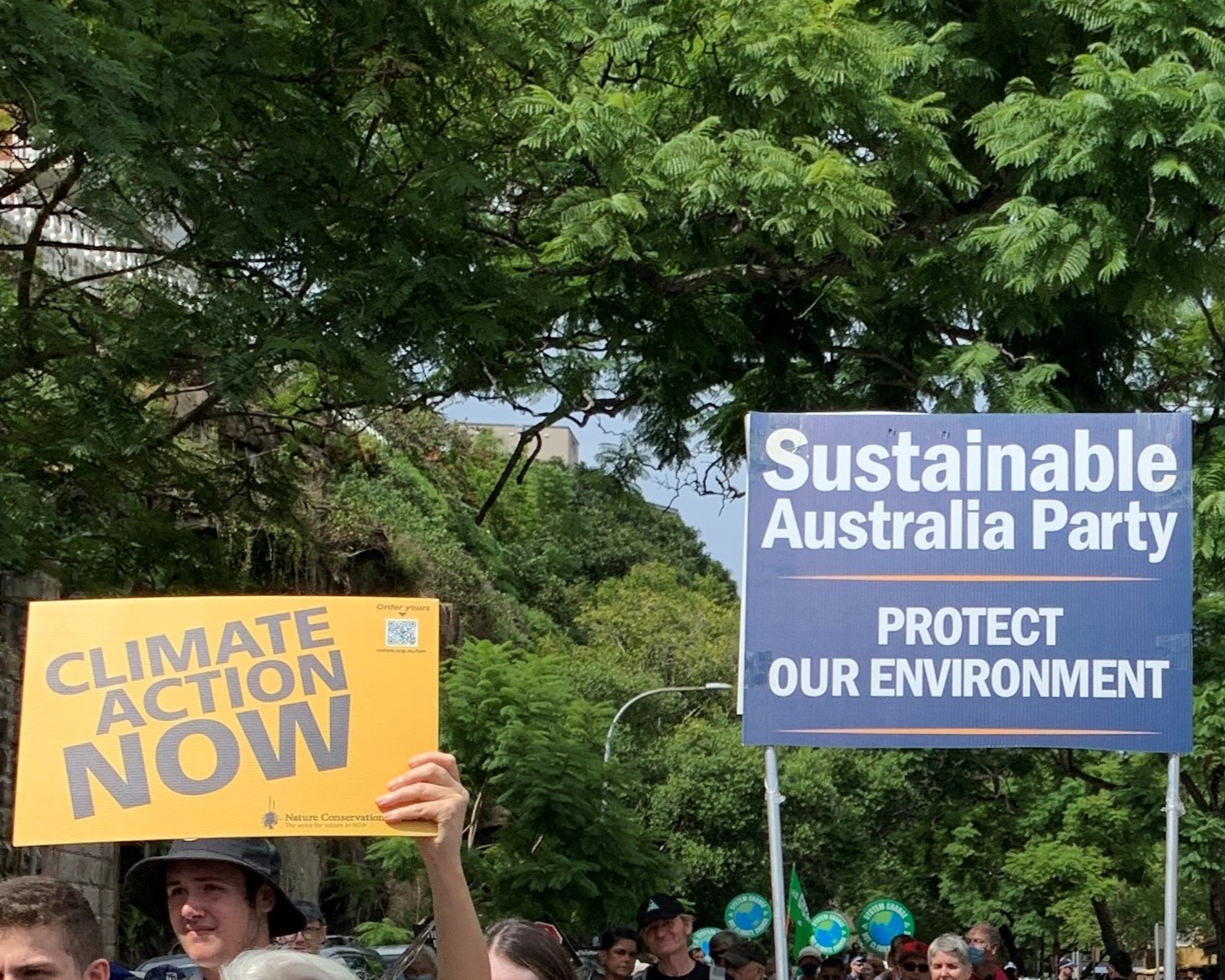
“The viability of our societies depends on leaders from government, business and civil society uniting behind policies, actions and investments that will limit temperature rise to 1.5 degrees Celsius.” Australian Broadcasting Corporation
“The world’s leading climate scientists have warned that the prospect of limiting global warming to 1.5C will be out of reach within 12 years at current rates of greenhouse gas emissions, in a report that finds it is now “unequivocal’’ that human activity is heating the planet.” The Australian [$]
Background – Climate change policies
SAP understands that as a global community we are losing the fight against climate change; the Australian government has the wrong policies; and Australia acting alone is pointless and counter-productive.
- Act on climate change and contribute globally to staying below 1.5 degrees global temperature rise compared to pre-industrial levels (2)
- Support international agreements to lower greenhouse gas emissions including a target of net zero emissions by 2035, ensuring that all high emitting countries meet the same or similar climate goals
- Reduce emissions by at least 75 per cent below 2005 levels by 2030, ensuring that all high emitting countries meet the same or similar climate goals
- Recognise that to achieve these ambitious targets and make them economically fair and environmentally meaningful, Australia must:
- Act to slow population growth then stabilise Australia’s population size (and related resource consumption) as soon as practicable (also see below)
- Work to urgently achieve a new global agreement that ensures all high emitting countries including economic competitors like China, USA and India meet the same or similar climate goals (also see Trade policy)
- Adopt a globally consistent carbon pricing mechanism that does not unfairly penalise Australian industries against their equivalent foreign competitor
- Place tariffs or bans on imports where any relevant carbon pollution has not been priced into the goods and services
- Slow population growth then stabilise Australia’s population size as soon as practicable (also see Population & Immigration policy)(3)
“The federal government’s State of the Environment 2016 report (prepared by a group of independent experts) predicts that population growth and economic development will be the main drivers of environmental problems such as land-use change, habitat destruction, invasive species, and climate change.” The Conversation
“Population growth had cancelled out three quarters of the global efforts to reduce carbon emissions in recent years.” PM
The greatest impact individuals can have in fighting climate change is to have one fewer child…” The Guardian
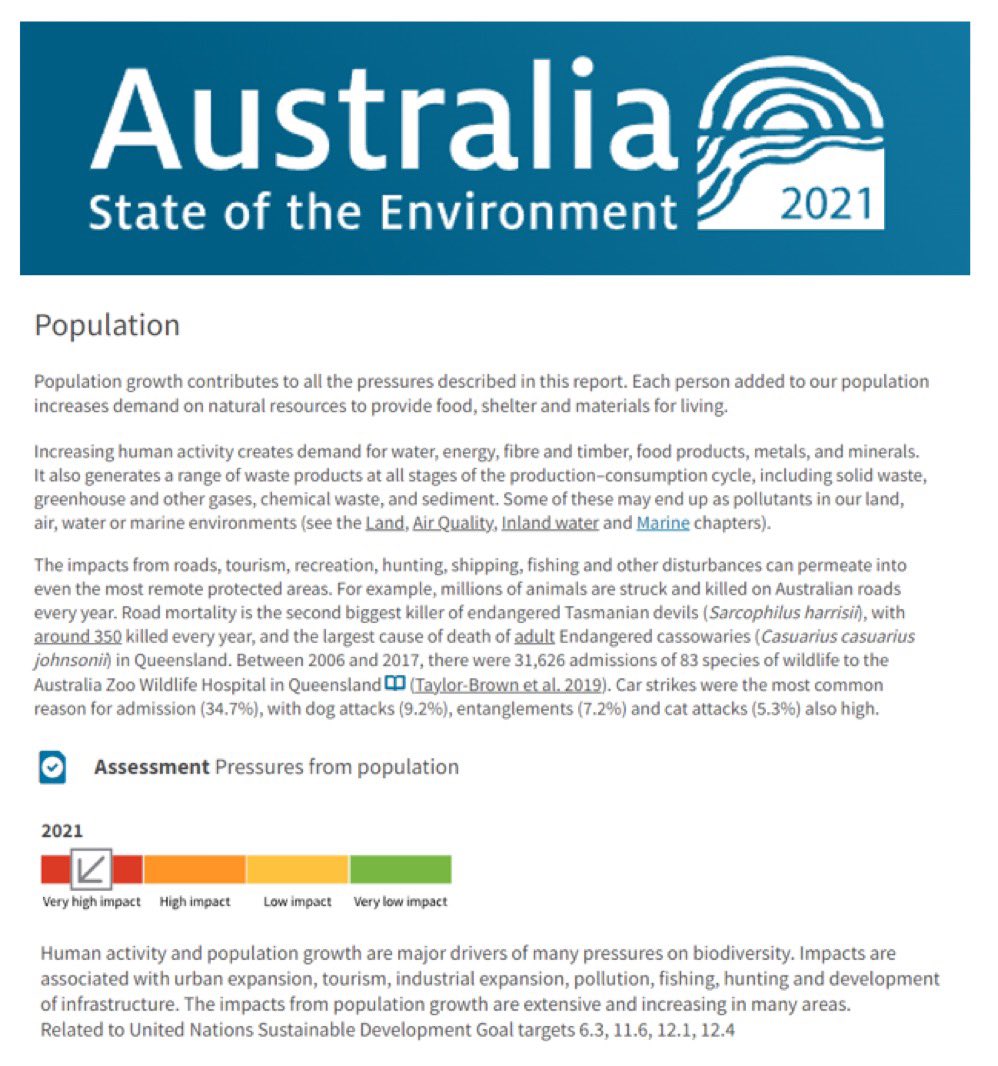
“Population growth contributes to all the pressures described in this report. Each person added to our population increases demand on natural resources to provide food, shelter and materials for living.” State of the Environment Report 2021
The Victorian Government’s Victorian Greenhouse Gas Emissions Report 2018, is further shocking evidence (unreported in the mainstream media) of how government-engineered rapid population growth is wiping out our efforts to reduce per capita (and therefore total) emissions.
- Fund and subsidise research and development into renewable energy technologies and energy efficiency initiatives
- Adopt a renewable energy target (RET) in line with our commitment on zero net emissions
- Implement a ban on all new coal mines in Australia
- Impose a moratorium on all new fracking, including for coal seam gas (also see Energy policy)
- Phase out fossil fuel subsidies